Many new activewear brands know how many garments they want to produce but struggle to decide how many pieces of each size to order. An unsuitable size breakdown can create excess inventory or early stockouts. A practical size allocation plan helps brands make better first-order decisions.
For a first activewear production run, brands should estimate size ratios using their target customers, garment fit, available sales signals, and order quantity. Rather than dividing production equally across S, M, L, and XL, start with a clearly labeled working size curve, convert percentages into whole-unit quantities, and confirm the breakdown against the manufacturer's MOQ requirements. Review actual demand and stockouts before planning the next order.
Here is how we recommend building a size allocation plan that works for customers, inventory, and practical garment manufacturing.
What Is a Size Ratio in Clothing Manufacturing?
An activewear size ratio describes how an order is distributed among sizes. It answers a purchasing question: out of 100 training shorts, how many should be small, medium, large, and extra large?
Size Chart vs. Size Ratio vs. Size Breakdown
A size chart defines garment or body measurements. A size ratio expresses the relative quantities of each size, while a size curve commonly expresses those shares as percentages. A size breakdown gives the actual number of units to produce in each size.
A size chart alone does not tell a factory how many medium pieces to cut.
How Does a Size Curve Work?
Suppose a brand uses a hypothetical curve of 15% S, 35% M, 35% L, and 15% XL. For a 100-piece order, that becomes 15 S, 35 M, 35 L, and 15 XL. The harder question is whether those shares match your audience.
Should You Order Equal Quantities of Every Size?
Equal distribution is simple but can cause one size to sell out while another remains unsold.
Why Equal Size Distribution Can Create Inventory Problems
Unsold units tie up cash; popular sizes selling out can mean missed demand. Both hurt a first collection.
Why There Is No Universal Size Ratio
Do not copy a 1:2:2:1 ratio without considering your market, size standards, fit, and product category. An online example is not evidence of your buyers' demand.
How Can New Activewear Brands Estimate Size Demand Without Sales History?
Without sales history, a starting curve is a forecast—not a fact.
Define Your Target Customer
Define the target customer: strength-training shorts, relaxed athleisure, or fitted compression wear? Identify your sales market and sizing system.
Clarify your target audience and initial product range before deciding quantities.
Collect Early Size Preference Data
Gather signals from potential customers through fittings, size surveys, or a limited preorder with a clear size guide.
Record selected sizes and actual fit. Preorders are stronger signals than polls; a few friends do not represent a whole market.
Create a Starting Size Curve
Create provisional percentages and document their source, date, and product. With limited evidence, keep the first run controlled.
Label it an estimate, not a proven demand curve.
For example, a brand might gather 40 usable size preferences from prospective customers. That sample can help identify which sizes need attention, but it does not establish the full market distribution. Check whether the respondents match your intended buyers, whether they used your actual size chart, and whether their choices reflect an intention to purchase. A small survey should inform the first allocation, not dictate it without further judgment.
How Do You Calculate Size Ratios for 50, 100, or 300 Pieces?
This example uses illustrative percentages only, not MAIDA sales data or market averages.
Step 1 — Assign a Percentage to Each Size
Start with a curve that totals 100%. In our example, S and XL each receive 15%, while M and L each receive 35%.
Step 2 — Convert Percentages Into Garment Quantities
Multiply the total order quantity by each size percentage. For instance, 100 × 35% = 35 medium pieces. Repeat for every size.
Step 3 — Round Quantities Without Changing the Order Total
Garments must be ordered as whole pieces. For 50 units, the ideal calculations are 7.5, 17.5, 17.5, and 7.5. One valid allocation is 8, 17, 17, and 8. Other valid allocations exist; always reconcile the total.
| Size | Example ratio | 50 pcs | 100 pcs | 300 pcs |
|---|---|---|---|---|
| S | 15% | 8 | 15 | 45 |
| M | 35% | 17 | 35 | 105 |
| L | 35% | 17 | 35 | 105 |
| XL | 15% | 8 | 15 | 45 |
| Total | 100% | 50 | 100 | 300 |
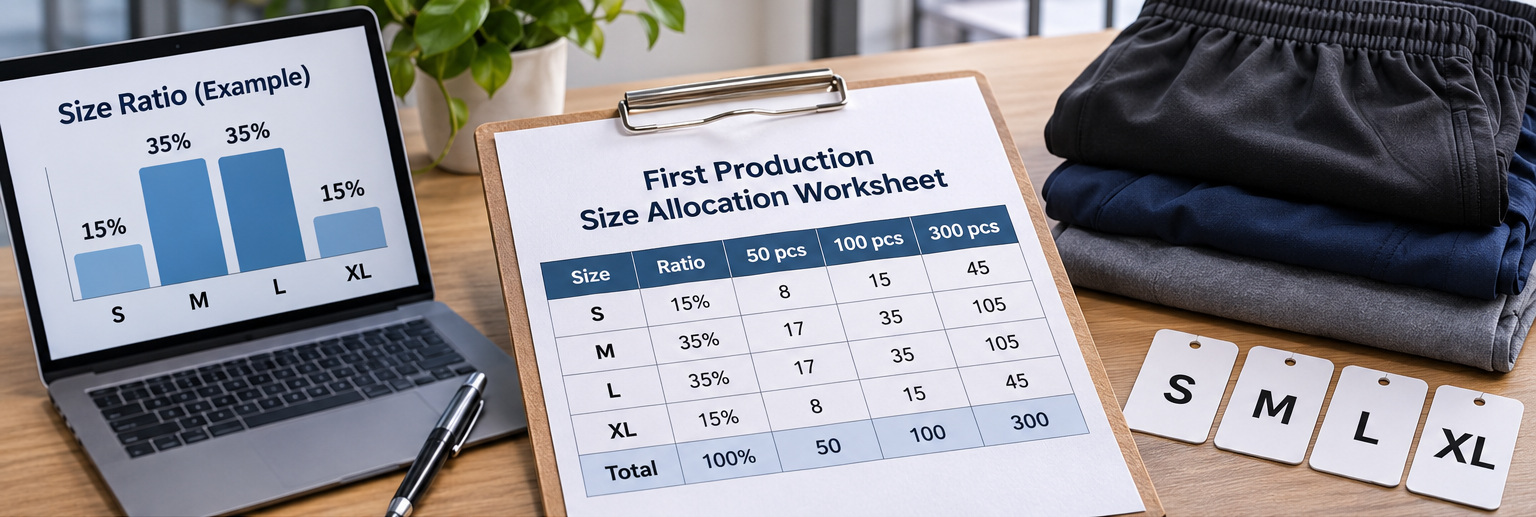
Rounding makes the 50-piece shares 16%, 34%, 34%, and 16%. Confirm the adjustment with the manufacturer.
How Do Fit and Product Type Affect Size Distribution?
Customers may choose different sizes across products, so validate demand by garment.
Relaxed-Fit vs. Compression Activewear
Relaxed training shorts, close-fitting leggings, compression tops, and oversized T-shirts have different fit intentions. Some buyers deliberately size up or down depending on the product. If customers misunderstand the intended fit, their stated size preferences may not translate into satisfactory purchases.
Test sample fit and sizing guidance for each product.
Why Size Ratios Should Be Product-Specific
Do not automatically reuse a shorts allocation for compression shirts or hoodies. Forecast each style separately unless evidence supports combining demand.
How Do Colors and Factory MOQ Requirements Affect Size Planning?
A total order of 100 pieces is not yet a complete production instruction. The factory also needs to know how many garments to make in each style, color, and size.
Garment MOQ vs. Minimum Quantity Per Size
MOQ may apply by style, color, or size. Some factories accept mixed sizes, while others have cutting or color minimums. Confirm the rules for your order.
How to Build a Color-by-Size Order Matrix
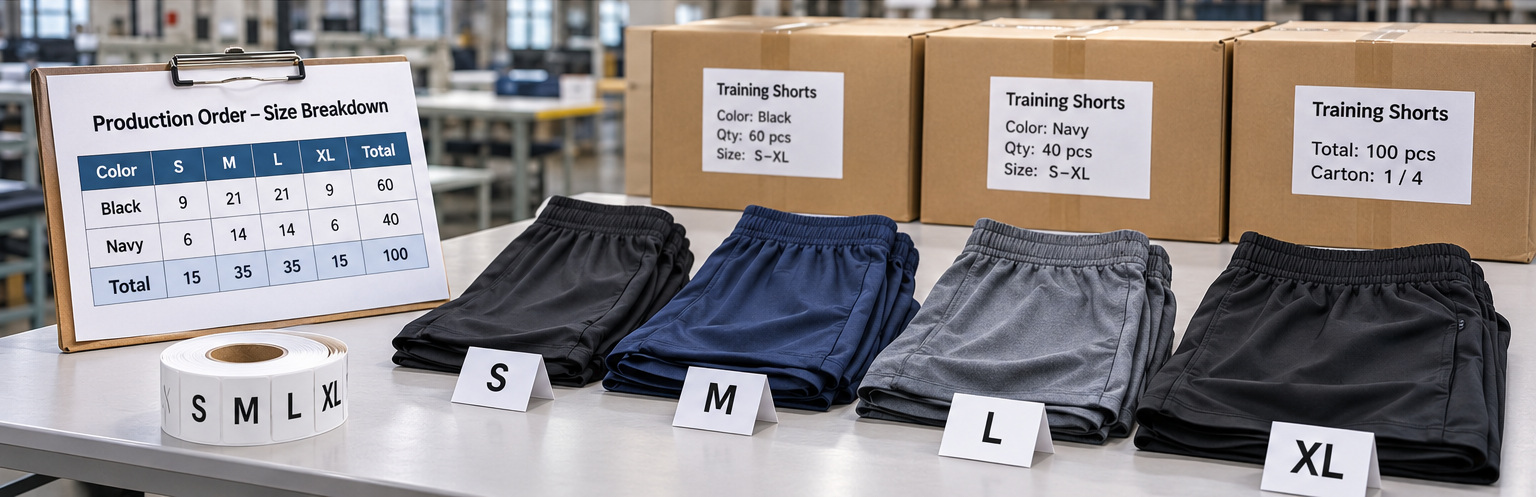
Suppose a brand wants 100 shorts: 60 black and 40 navy. Applying the same illustrative curve to both colors gives the following purchase breakdown.
| Color | S | M | L | XL | Total |
|---|---|---|---|---|---|
| Black | 9 | 21 | 21 | 9 | 60 |
| Navy | 6 | 14 | 14 | 6 | 40 |
| Total | 15 | 35 | 35 | 15 | 100 |
Reconcile every row and column. Real size demand may differ by color.
What Should You Confirm Before Placing the Order?
Ask whether the manufacturer permits your selected size breakdown, what quantities are required per color, and whether size-specific labels or packaging are included. On a custom gym shorts manufacturing project, the approved size chart and final order matrix should refer to the same style version.
Specify whether totals include any agreed spare pieces. Request written approval of the final matrix so purchasing, cutting, labeling, and packing teams work from the same figures.
How Should Brands Adjust Size Ratios for Their Next Production Run?
The most useful size curve is one you improve with real information. After launch, record the outcome for each size rather than examining only total revenue or overall sell-through.
Compare Sales With Available Inventory
Track units sold, inventory, and days available. Twenty sales with continuous stock are not equivalent to twenty sales with frequent stockouts.
Account for Stockouts and Returns
Stockouts can hide demand. A customer cannot buy a size that is unavailable, so low recorded sales do not necessarily mean low interest. Conversely, frequent size-related returns may signal a fit or size-guide problem rather than excessive demand for a particular label.
Review exchanges and feedback alongside sales to distinguish stock shortages from fit problems.
A simple weekly report can show each size's opening stock, sales, returns, and days out of stock. Look at trends across several weeks where possible. If medium repeatedly sells out early, investigate unmet demand before reducing its share because its recorded sales seem low. If extra large has a high return rate, review fit feedback before simply ordering fewer pieces.
Update the Size Curve Before Reordering
Use available evidence to adjust the next breakdown and recheck MOQ. A new fit, sizing system, or market may invalidate past trends.
What Should Brands Confirm With Their Manufacturer?
Factories need exact quantities, not instructions such as “mostly medium and large.” Attach an approved worksheet to the purchase order.
| Checkpoint | What to confirm |
|---|---|
| Style reference | Product code, garment version, and approved design |
| Size range | Exact size labels, such as S–XL or XS–2XL |
| Size chart | Approved measurements, grading, and revision date |
| Color breakdown | Quantity ordered in each approved color |
| Size breakdown | Whole-unit quantity for every color-size combination |
| MOQ rules | Applicable minimums per style, color, or size |
| Total quantity | Row totals, column totals, and purchase order total agree |
| Packing | Size labels, individual packaging, and carton assortment |
Before authorizing production, cross-check these entries with the agreed specifications. Our separate guide to approving gym shorts before bulk production covers the broader production-approval process.
Frequently Asked Questions
What Is a Common Size Ratio for a First Clothing Order?
There is no universal first-order ratio that works for every clothing brand. Some businesses use a simple starting curve, but its suitability depends on customer demand and the sizing of the specific garment. Use any published ratio as an assumption to test, not a market fact.
Is a 1:2:2:1 Size Ratio Suitable for Activewear?
A 1:2:2:1 ratio assigns one share each to the smallest and largest sizes and two shares each to the middle sizes. It can demonstrate how allocations work, but it is not automatically appropriate for gym shorts, compression wear, or every audience. Validate it before purchasing inventory.
Can I Mix Different Sizes in a 50-Piece Order?
Often it is possible to request mixed sizes, but the answer depends on the factory, garment construction, and minimums applying to the style or color. Ask your manufacturer to approve the complete size-by-color breakdown before paying a deposit.
Should Men's and Women's Activewear Use the Same Size Ratio?
Not by default. Different target customers, garment measurements, fit expectations, and product categories can produce different size demand. Build separate estimates unless you have reliable evidence that the same distribution works for both collections.
How Do I Know Which Sizes to Restock First?
Review sales by size, stock availability, returns, exchanges, and customer requests. Prioritize sizes showing sustained demand, but remember that a stockout may suppress reported sales. Recalculate your order using available evidence rather than copying the first allocation unchanged.
Final Thoughts
Planning an activewear size ratio means balancing expected customer demand, inventory risk, and manufacturing requirements. Start with a documented estimate, convert it into a clear size breakdown, and improve it with real sales data. The first run does not need a perfect forecast—it needs a sensible, reviewable decision.