Skip to content

A camouflage pattern may look impressive on a digital mockup but appear completely different on finished gym shorts. Incorrect print scale, color differences, unsuitable fabrics, and unclear artwork rights can create costly production problems. A structured development process helps brands turn their designs into consistent, production-ready products.
To develop custom camo gym shorts, brands should start with original or properly licensed camouflage artwork, confirm the pattern repeat and actual print scale, select compatible performance fabrics, and choose an appropriate printing method. Before bulk production, they should approve physical print samples, garment construction, pattern placement, and a production-ready sample. Clear specifications help manufacturers reproduce the approved design consistently.
Developing camouflage sportswear involves more than selecting a pattern. The following steps explain how brands can move from artwork development to finished garment production while reducing avoidable mistakes.
1. How Can Brands Create an Original Camouflage Pattern?
Define the Visual Direction Before Designing
The first step is to establish a clear visual direction.
Camouflage-inspired designs can incorporate woodland tones, desert palettes, urban colors, or abstract geometric shapes. However, brands should develop their own artwork rather than directly reproducing recognizable commercial patterns without appropriate permission.
The intended product also influences the design.
A subtle camouflage pattern may suit everyday training shorts, while a bold, high-contrast design may work better for streetwear-inspired activewear.
Brands should consider their target audience, color palette, garment silhouette, and overall collection identity before preparing the final artwork.
Build a Repeatable Pattern for Fabric Printing
A pattern that looks attractive in a single image may not work correctly when repeated across several meters of fabric.
For continuous fabric printing, the artwork generally needs a repeatable layout.
A seamless repeat allows the edges of the design to connect without visible interruptions.
Designers should define the repeat width, repeat height, and pattern orientation.
These specifications help printing suppliers prepare fabric consistently and reduce unexpected gaps or unwanted visual repetition.
2. How Can Brands Check Camouflage Artwork Rights Before Production?
Original Artwork, Licensed Patterns, and Third-Party Designs
Before submitting camouflage artwork to a manufacturer, brands should understand where the design originated.
Artwork may be created internally, commissioned from a designer, or obtained under a commercial license.
However, purchasing a design file does not automatically mean the buyer owns every intellectual property right associated with it.
Licenses may restrict reproduction, modification, distribution, or use in certain product categories.
The situation can be more complicated when a pattern resembles a recognizable military or commercial camouflage design.
Why Changing Colors Does Not Automatically Remove Copyright Risk
Changing the colors of an existing camouflage pattern does not necessarily make it an independent design.
Copyright protection, where applicable, may extend to the original arrangement and expression of graphic elements.
Likewise, AI-generated camouflage should not automatically be assumed to be free from third-party intellectual property concerns.
Brands should review artwork sources, licensing conditions, and potential similarities before authorizing commercial production.
Original Camouflage Artwork Rights Checklist
| Verification Item | What Brands Should Confirm |
|---|---|
| Artwork Source | Original, commissioned, or licensed |
| Ownership | Who owns the relevant rights? |
| Commercial Permission | Is apparel production permitted? |
| Modification Rights | Can colors, scale, and shapes be modified? |
| Manufacturing Rights | Can an external factory reproduce the artwork? |
| Sales Territories | Are the intended markets covered? |
| Documentation | Are contracts and supporting records available? |
This checklist supports commercial artwork verification. It is not a substitute for legal advice, and completing it does not guarantee that a design is free from infringement risks.
3. What Artwork Files Are Needed for Custom Camo Fabric Printing?
Vector Files vs. High-Resolution Raster Artwork
Manufacturers may request artwork in formats such as AI, EPS, PDF, TIFF, or PSD.
Vector files are useful for designs with editable shapes and clearly defined graphic elements.
However, complex camouflage textures do not always need to be converted into vectors.
High-resolution raster artwork may also be suitable when the image quality, dimensions, and printing requirements are appropriate.
A large digital file is not necessarily a production-ready file.
Brands should confirm the actual printing dimensions and required resolution with their printing supplier.
Define the Repeat Size and Print Dimensions
Pattern repeat dimensions should be documented in centimeters or another agreed measurement unit.
For example, a design file may have a repeat width of 30 cm and a repeat height of 30 cm.
If the same artwork is enlarged during production, the camouflage elements will become larger and less densely distributed.
Brands should therefore specify whether the artwork will be printed at its original size or at an approved scaling percentage.
Prepare Colors and Production Instructions
The final artwork package should include color references, orientation instructions, repeat dimensions, and file version information.
Screen colors may differ from printed fabric because of the printing process, substrate, and color management conditions.
For this reason, physical print samples should be approved before bulk fabric printing.
4. How Does Camouflage Pattern Scale Affect the Final Appearance of Gym Shorts?
Small-Scale vs. Large-Scale Camouflage Prints
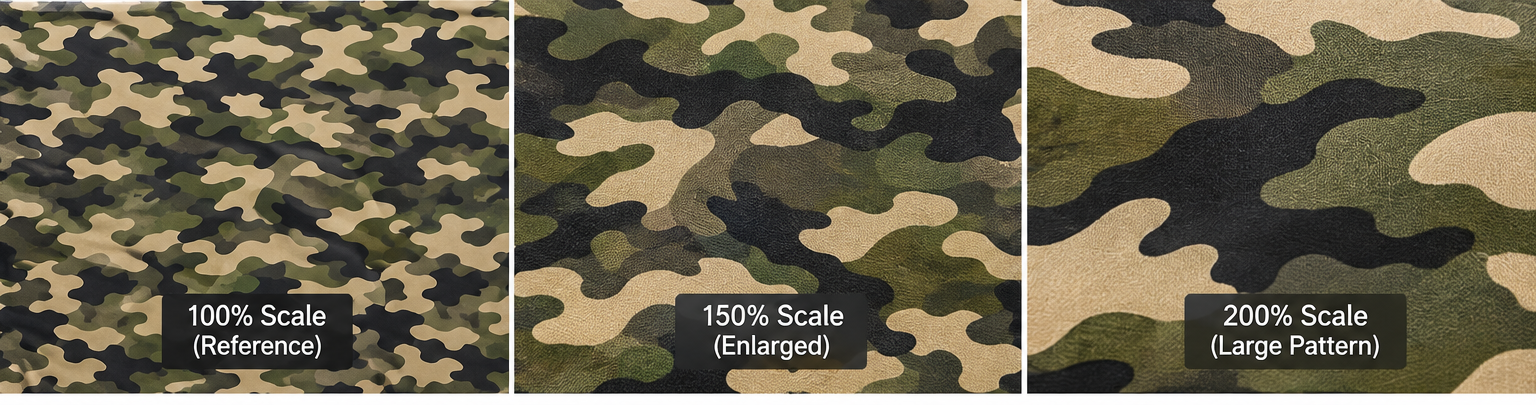
Pattern scale can dramatically change the visual appearance of custom camo gym shorts.
A small-scale repeat creates a dense arrangement of camouflage elements.
A larger repeat makes individual shapes more prominent and may produce a bolder appearance.
For example, printing the same pattern at 100%, 150%, and 200% scale changes the physical size of every element.
These percentages are illustrative comparisons, not standard printing recommendations.
The correct scale depends on the intended design, garment dimensions, and visual effect.
Why Pattern Scale Must Be Approved at Actual Print Size
Digital mockups are useful for evaluating the overall appearance of a garment, but they may not accurately represent the physical dimensions of a print.
A camouflage pattern displayed on a computer screen can appear balanced even when the production repeat is too small or too large.
Brands should review a print sample at its intended physical scale.
When possible, the sample should be assessed against actual garment pattern pieces.
This helps identify unexpected differences between the artwork preview and the finished shorts.
How to Avoid Unexpected Cropping on Different Sizes
Camouflage elements will appear differently across small and large garment sizes because the fabric pieces have different dimensions.
A large camouflage shape might occupy most of one leg panel on a small size but represent a smaller proportion of a larger panel.
For randomly distributed all-over prints, exact placement may not be necessary.
However, brands should confirm acceptable pattern variation before production.
5. Which Fabrics Work Best for Custom Camo Gym Shorts?
Polyester-Spandex Woven Fabrics
Polyester-spandex woven fabrics are commonly considered for training shorts because they can offer stretch, relatively low weight, and suitable durability for activewear applications.
Polyester also works with conventional dye sublimation processes when the fabric and printing system are compatible.
This makes polyester-based materials a practical option for many all-over camouflage designs.
However, fabric performance depends on construction, yarn selection, finishing, and testing rather than fiber composition alone.
Nylon-Spandex Performance Fabrics
Nylon-spandex fabrics are another option for performance shorts.
Depending on their construction and finishing, they can provide a soft hand feel, flexibility, and abrasion resistance.
However, standard polyester dye sublimation processes are not generally interchangeable with printing methods required for nylon.
Manufacturers must evaluate suitable inks, dyes, pretreatments, and fixation processes.
Brands should not assume that a camouflage design can be transferred between polyester and nylon without additional development.
Fabric Weight, Stretch, and Print Compatibility
Fabric weight influences the feel, drape, and intended use of gym shorts.
Lighter fabrics may suit running and warm-weather activities, while heavier constructions may provide a different structure and hand feel.
The selected fabric should also provide the desired stretch and recovery.
Before approving a material, brands should evaluate its printing compatibility, color appearance, dimensional stability, and intended performance.
For more information about selecting materials and garment construction, explore our custom gym shorts manufacturing solutions.
6. Sublimation vs. Digital Textile Printing: Which Method Should Brands Choose?
How Dye Sublimation Works on Polyester Fabrics
Dye sublimation is commonly used for printing colorful patterns on suitable polyester fabrics.
The process uses heat to transfer disperse dyes into the polyester material.
Because the color is incorporated into the fibers rather than forming a conventional surface film, this method can produce detailed all-over camouflage designs without a heavy printed texture.
However, fabric composition, surface treatment, temperature, and process settings affect the final result.
When Other Digital Textile Printing Methods May Be Appropriate
Digital textile printing is a broad category that includes different ink and dye technologies.
Depending on the fabric, manufacturers may use processes involving reactive, acid, pigment, or disperse dye systems.
Each method has different requirements for preparation, fixation, washing, and finishing.
The correct process should be selected according to the textile substrate, desired appearance, performance requirements, and available production equipment.
Why Sample Printing Matters More Than Digital Mockups
The same digital camouflage file can look different when printed on different fabrics.
Surface texture, fabric color, ink absorption, and finishing processes can influence the result.
Before approving production, brands should examine a physical print sample under appropriate lighting.
Important checks include color appearance, pattern definition, fabric hand feel, and consistency with the approved artwork.
7. How Should Camouflage Patterns Be Positioned Across Waistbands, Pockets, and Seams?
All-Over Printing vs. Engineered Pattern Placement
All-over printing allows camouflage patterns to extend across the garment without requiring every element to occupy a predetermined position.
Engineered placement printing uses a more controlled layout, aligning artwork with specific garment pattern pieces.
Engineered printing may be appropriate when a brand wants certain visual elements positioned consistently.
However, it requires more detailed production planning and alignment.
Should Camo Patterns Match Across Side Seams?
Not every camouflage design requires exact matching at the side seams.
For randomly distributed patterns, slight variations between adjacent panels may be acceptable.
If the brand requires continuous graphic alignment, this must be specified before cutting.
Matching complex shapes across seams can influence fabric consumption, cutting arrangements, and production efficiency.
Common Problems Around Waistbands, Pockets, and Side Slits
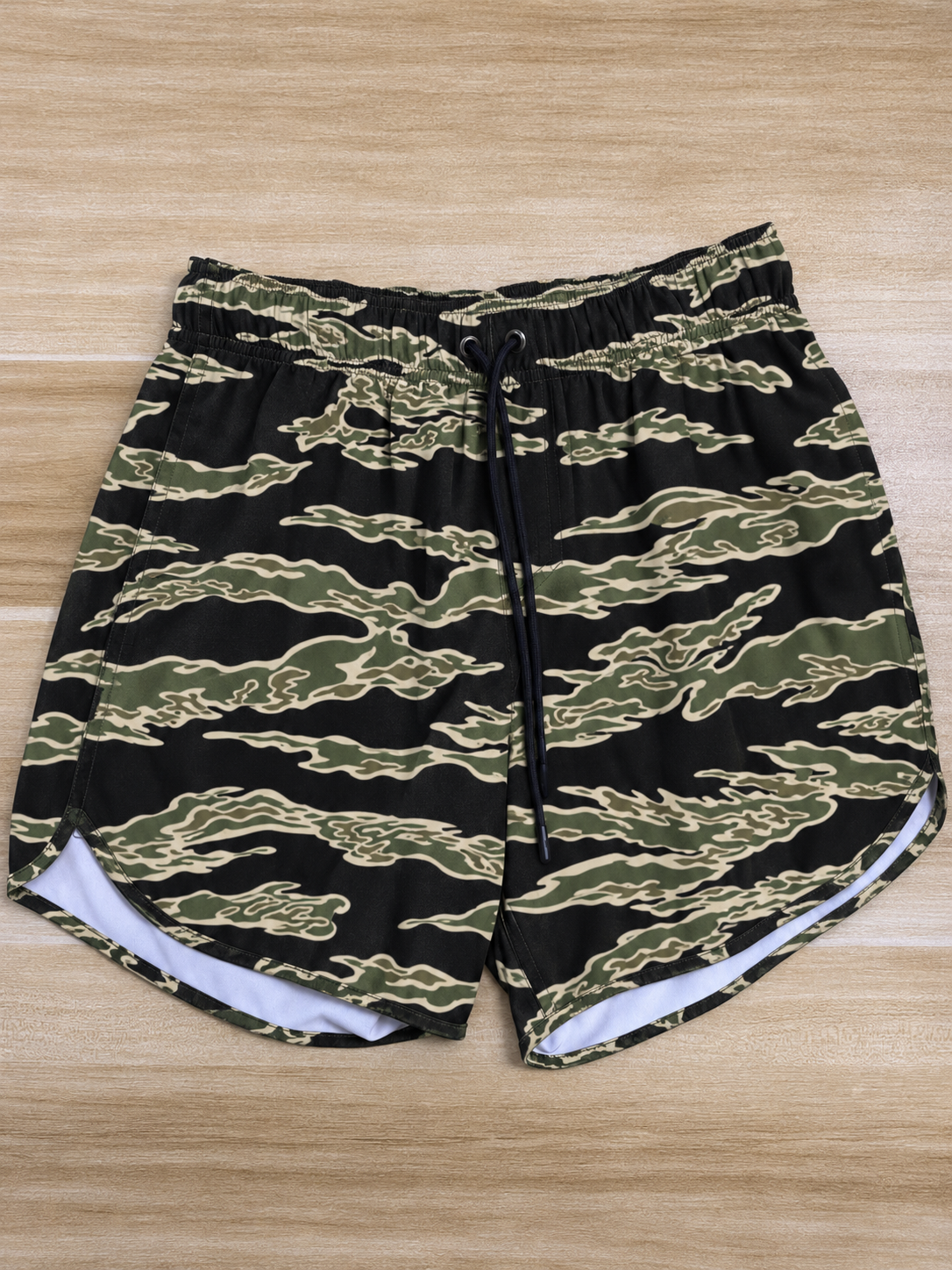
The waistband, pocket panels, side seams, and side slits can interrupt the appearance of a continuous camouflage design.
Different fabric orientations may also change how the pattern appears.
Brands should specify whether these components use the same camouflage fabric, contrasting materials, or controlled pattern placement.
For additional garment construction considerations, see our guide to designing shorts for hybrid fitness training.
8. What Should Brands Approve Before Bulk Camo Shorts Production?
Confirm the Physical Print and Finished Sample
Approving a digital mockup is not the same as approving a production sample.
A complete development process should include artwork confirmation, physical print evaluation, and finished garment approval.
The final sample should reflect the intended fabric, printing method, waistband, pockets, stitching, and accessories.
Brands should also confirm whether the camouflage placement is random or controlled.
Build a Production-Ready Specification Sheet
A production specification sheet helps manufacturers maintain consistency during bulk production.
It should identify the approved artwork version, print scale, repeat dimensions, fabric requirements, color references, and garment construction details.
Original Camouflage Print Development Checklist
| Production Item | Approval Requirement |
|---|---|
| Artwork File | Approved final production version |
| Pattern Repeat | Confirmed width, height, and alignment |
| Print Scale | Approved physical dimensions |
| Fabric | Composition, weight, and construction |
| Printing Method | Compatible process confirmed |
| Color Reference | Approved physical print sample |
| Pattern Placement | All-over or engineered placement |
| Waistband and Pockets | Material and pattern requirements |
| Size Range | Acceptable pattern distribution |
| Finished Sample | Construction and appearance approved |
| Bulk Tolerance | Agreed inspection criteria |
The checklist should form part of the approved production documentation.
Any changes to artwork, fabric, or printing settings should be reviewed before implementation.
9. How Can Brands Maintain Consistent Camo Prints During Bulk Manufacturing?
Control Artwork Versions, Fabric Lots, and Print Settings
Bulk production consistency begins with clear specifications.
Manufacturers should work from the approved artwork files and maintain appropriate production records.
Changes in fabric batches, printing conditions, or finishing processes may affect color and appearance.
Compare Bulk Production Against Approved Samples
Physical print samples and approved finished garments provide useful references for production inspection.
Brands and manufacturers should define acceptable differences in color, pattern distribution, and garment construction.
Inspection methods should be appropriate for the product and agreed before production.
Define Realistic Print Placement Tolerances
All-over camouflage prints may naturally show variations in pattern distribution between garments.
These differences should not automatically be treated as defects if random placement was approved.
However, engineered printing requires more specific positional controls.
Clear requirements help prevent disagreements during bulk inspections.
Frequently Asked Questions About Custom Camo Gym Shorts
Can Brands Legally Use Military Camouflage Patterns?
It depends on the specific pattern, applicable intellectual property rights, and any required permissions.
Some camouflage designs may involve copyright, trademark, or other legal considerations.
Brands should verify the relevant rights before commercial production.
Can I Create My Own Camouflage Pattern for Gym Shorts?
Yes. Brands can develop original camouflage-inspired artwork using their own shapes, colors, and design arrangements.
However, they should also consider potential similarities to existing protected designs and confirm that the artwork is suitable for commercial use.
What Is the Best Printing Method for Custom Camo Shorts?
The most appropriate method depends on the fabric and desired result.
Dye sublimation is commonly used for compatible polyester fabrics, while other fibers may require different textile printing systems.
Physical testing is recommended before production approval.
Should Camouflage Patterns Match at Every Seam?
Not necessarily.
Random all-over camouflage prints may allow natural pattern variation, while engineered designs may require more precise alignment.
The brand should confirm its expectations before cutting and sewing.
Can the Same Camo Artwork Be Used for Shorts, Shirts, and Accessories?
Yes, provided the relevant commercial usage rights allow it.
However, pattern scale and placement may need adjustment for different garment sizes, fabric types, and product constructions.
A separate physical sample may be necessary for each product category.
What Should Brands Send to a Custom Camo Shorts Manufacturer?
Brands should provide the approved camouflage artwork, print dimensions, color references, fabric preferences, garment design, size specifications, and construction requirements.
They should also clarify pattern placement expectations, artwork permissions, and sample approval criteria.
Final Thoughts: Turn Original Artwork Into Production-Ready Camo Shorts
Developing custom camo gym shorts requires careful coordination between artwork design, textile printing, garment construction, and production approval.
By confirming pattern rights, physical print scale, fabric compatibility, and manufacturing specifications before bulk production, brands can reduce avoidable mistakes and achieve more consistent results.
Explore our custom gym shorts manufacturing services or view an example of our camouflage running shorts to learn more about available product development options.