Skip to content

Your gym shorts sample looks right, but is the factory ready to reproduce it across every size and color? Approving the appearance alone can leave gaps in materials, measurements, branding, and inspection standards. Those gaps become expensive once cutting begins. A documented production approval process helps prevent them.
Before starting bulk gym shorts production, brands should approve the final sample, current tech pack, bill of materials, fabric and trims, size specifications, artwork, order breakdown, packaging, and quality-control plan. Each approval must identify its reference version and any unresolved issues. The factory should release cutting only when these records agree and critical decisions are closed.
From our factory perspective, the key question is not simply “Is the sample approved?” It is “Can every production department make the same approved shorts?”
What Does Production Approval Actually Mean?
Production approval is a controlled decision that allows a factory to manufacture a defined product to an agreed standard. It connects the physical sample with the written instructions used by purchasing, pattern making, cutting, sewing, printing, inspection, and packing teams.
For custom men's gym shorts, one small inconsistency can affect hundreds of pieces. A sample may have a soft elastic waistband, while the latest tech pack specifies self-fabric casing. Or the approved logo may be 40 mm wide, while an older artwork file shows 50 mm. The factory needs one final instruction.
Treat approval as a release package, not a “looks good” message. Every record should identify the same product version.
Which Tech Pack and Production Documents Must Be Final?
Freeze the tech pack, BOM, and revision history
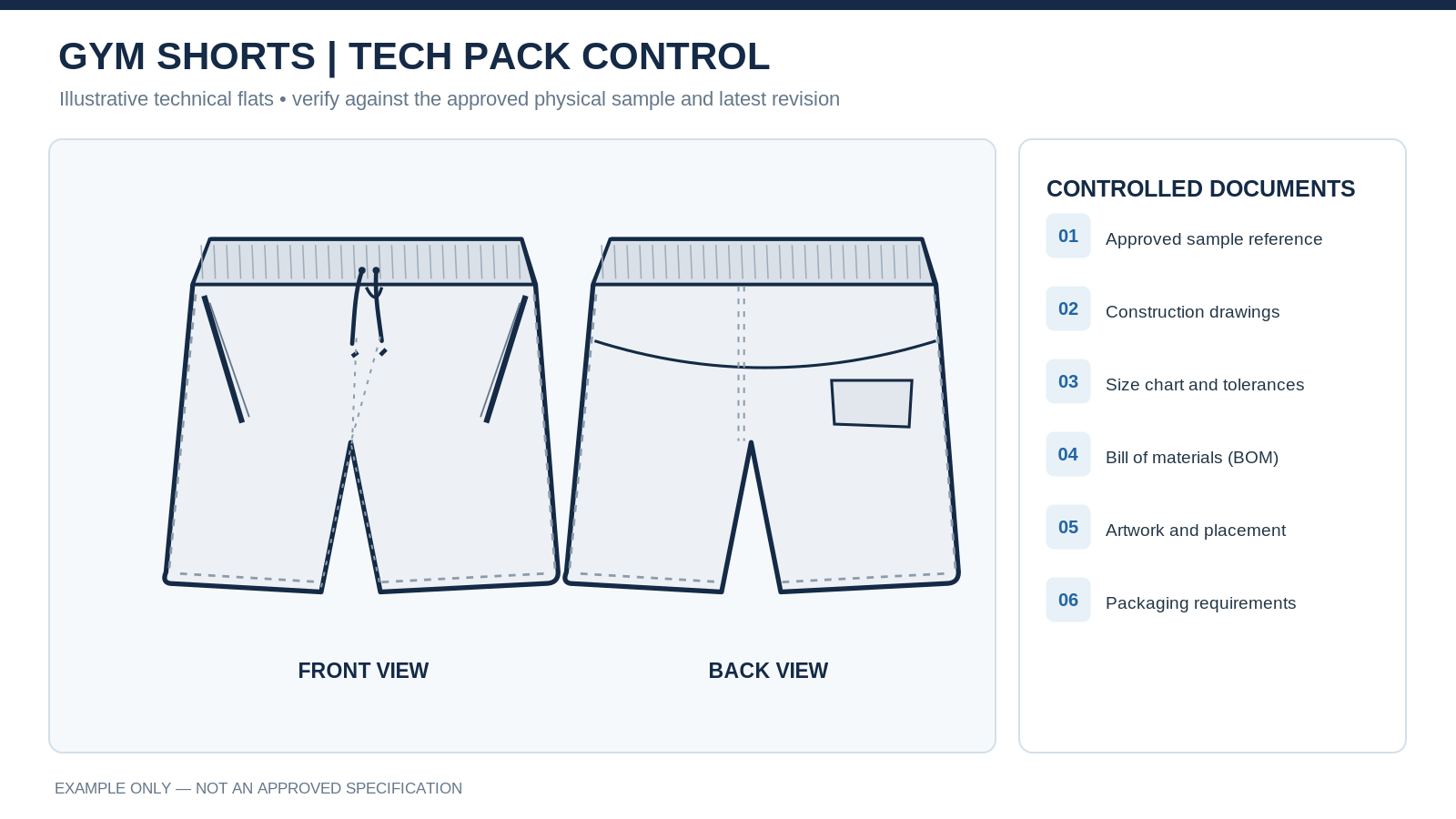
The final gym shorts tech pack should include technical sketches, construction notes, a measurement chart, points of measure (POM), grading rules, tolerances, branding positions, labels, and packaging requirements.
A bill of materials (BOM) lists each component: main fabric, pocket lining, elastic, drawcord, eyelets, zippers, labels, printing materials, and packaging. Identify the bulk component when a sample used a substitute.
Give documents a clear revision number and date. When a change is accepted, update the affected pages rather than relying on scattered chat messages. Keep one current master file.
Approve measurements, grading, and tolerances
Fit approval of a medium sample does not automatically prove that every other size is correct. Review the size range and grading, especially at the waistband, hip, thigh, front and back rise, inseam, outseam, and leg opening.
Measurement instructions should explain how the garment is laid flat and whether the elastic waist is measured relaxed or stretched. Without this, inspectors may report different results.
Set realistic tolerances for each POM in centimeters or inches. Do not assume one tolerance fits every measurement or fabric. Where fit is sensitive, request a size-set check before bulk cutting.
Have the Actual Fabrics, Trims, and Branding Been Approved?
Check production fabric, not only sample fabric
A sample may use available stock fabric to confirm fit while the bulk order uses a different lot or material. Similar compositions can still differ in stretch, texture, and drape.
Confirm composition, fabric construction, target GSM, color standard, stretch direction, finish, and any agreed performance requirements. For training shorts, these may include drying behavior, shrinkage, colorfastness, or abrasion resistance. Match tests to product claims and the target market.
Check bulk color against an approved physical swatch or lab dip under consistent lighting. Agree on shade controls before cutting.
Verify every functional detail
Functional details can be easy to miss: pocket depth, zipper opening, drawcord length, elastic width, liner attachment, mesh panels, side slits, reinforcement, or laser perforations.
For example, a 7-inch inseam does not define the entire fit. Rise and leg opening determine how the shorts sit and move. Similarly, “zippered pockets” is incomplete unless the pocket location, zipper type, opening length, and internal bag construction are documented.
For custom men's gym shorts, the more detailed the functional specification, the fewer decisions operators must make on the production line.
Sign off artwork, labels, and packaging
Approve the actual logo file, dimensions, color, method, and placement measured from fixed garment reference points. Confirm whether the branding is heat transfer, screen print, embroidery, or another process, and agree on appearance and durability requirements.
Check the main label, size label, care label, hangtag, barcode, polybag warning information where applicable, folding method, and carton marks. Required label content and product claims must be checked against the rules of the destination market.
A beautiful sample with the wrong size label is still a production error.
Is the Order Quantity Matrix Ready for the Factory?
A purchase order should translate directly into a clear style-color-size breakdown. The factory should not have to reconstruct quantities from separate messages.
For each SKU, confirm the style number, color name or code, size, quantity, branding variation, packing method, and shipment destination. Then reconcile the total against the quotation and purchase order. Also confirm any permitted overage or shortage, if relevant.
Imagine a 100-piece order split across black and navy. If the total is confirmed but the size allocation is still changing, cutting cannot be planned reliably. Revising quantities after fabric allocation may create shortages or unused material.
Also confirm price, payment, delivery terms, and production schedule. Commercial agreement does not replace technical approval.
What Quality Standards Should Be Agreed Before Production?
Define defects before they become disputes
A useful bulk clothing quality-control plan tells inspectors what to check, when to check it, and what result is acceptable. For gym shorts, priority areas may include stitching strength, seam alignment, waist elasticity, pocket function, print adhesion, measurement consistency, and visible fabric defects.
Classify defects as critical, major, or minor according to the agreed inspection policy. For example, a broken zipper that prevents normal pocket use may be considered major; a small loose thread may be minor. The classification should be written down, not decided after a shipment is finished.
If using an AQL-based final inspection, specify the sampling standard, inspection level, defect limits, lot definition, and acceptance procedure. AQL is a sampling method, not a promise that every garment is defect-free. The chosen plan should suit the order and commercial agreement.
Put inspections at the right production stages
Final inspection alone cannot reliably recover fabric already cut to the wrong dimensions. We prefer a layered control approach: incoming material checks, first-piece approval after cutting and sewing, in-line inspections, and a final check before packing or shipment.
The first completed garments should be compared with the sealed reference sample and the current tech pack. If a measurement, logo position, or pocket construction is drifting, stop and correct the process before the issue spreads.
Document what happens when a defect exceeds the agreed limit: rework, segregation, additional inspection, replacement, or a buyer decision. Define corrective action in advance.
Is an Approved Sample Enough to Start Bulk Production?
Not always. A fit sample proves that a particular garment can meet the intended fit or design. A pre-production sample (PPS), when required, should demonstrate the final approved construction using the specified production materials and trims as closely as practical.
Compare the PPS with the approved sample, tech pack, BOM, measurements, and branding artwork. If the bulk fabric, zipper, liner, or decoration differs from the fitting sample, assess whether the change affects fit, performance, appearance, or durability.
Not every administrative correction requires a new sample. But material or construction changes need explicit acceptance. Ask for a revised sample, component approval, or test evidence when the risk justifies it.
See our guide to sampling and the custom gym wear production process.
The Gym Shorts Bulk Production Approval Matrix
This is the checklist we would use as a practical sign-off conversation between a brand and its factory. Adapt the evidence and owner columns to your own order.
| Approval area | Evidence to check | Responsible sign-off |
|---|---|---|
| Sample and fit | Identified approved sample; comments closed | Brand + factory technician |
| Tech pack and BOM | Final revision, construction, materials | Brand + production team |
| Size specifications | POM chart, grading, tolerances, measurement method | Brand + pattern/QC team |
| Bulk fabrics and trims | Approved swatches, colors, components, relevant tests | Brand + sourcing/QC team |
| Branding and labels | Final artwork, placements, label content, approved method | Brand + decoration team |
| Order matrix | Style-color-size quantities and PO totals | Brand + merchandiser |
| Quality plan | Defect definitions, checkpoints, sampling method | Brand + factory QC |
| Packing and shipment | Packaging, barcodes, carton requirements, delivery terms | Brand + shipping team |
| Production release | Approval date, reference versions, remaining conditions | Named authorized approvers |
Use three possible statuses: Approved, Approved with written conditions, or On hold. A conditional approval should identify exactly what can proceed and what cannot. For example, fabric ordering may proceed while cutting remains on hold.
A release note can read: “Style GS-01, Tech Pack Rev 04, BOM Rev 03, PPS dated [date]: approved for bulk cutting in black, sizes S–XL, quantities per PO [number].” Add any exceptions and the approver's name.
Which Production Risks Can Still Delay or Damage an Order?
Uncontrolled changes after sign-off
A buyer may request a larger logo or a new drawcord after approving the sample. The adjustment may appear simple, but it can affect artwork files, supplier bookings, cost, and delivery. Log every post-approval change, explain its impact, and obtain written acceptance before implementation.
Material substitutions without review
Replacing a zipper, changing fabric GSM, or using another mesh can alter durability and appearance. Ask the factory to propose alternatives with clear photos, specifications, and any testing or resampling needed. Silence should never count as approval.
Approval that does not reach the production floor
A design may be correct in the sales conversation but outdated in the cutting room. The practical solution is one controlled production package shared with relevant departments, plus a pre-production meeting to review unresolved items. Use the current version on the factory floor.
Frequently Asked Questions
Who should approve gym shorts before bulk manufacturing?
The brand's authorized decision-maker should approve design, fit, materials, branding, quantities, and commercial terms. The factory's responsible technical, production, and QC personnel should confirm feasibility and use the same approved references. Name both parties in the release record.
Can I approve a pre-production sample using photos?
Photos and video can confirm visible details, but they cannot reliably prove fabric hand feel, stretch recovery, measurement accuracy, or comfort. Physical samples or documented tests are preferable for fit-critical or performance-critical decisions.
When should the factory start cutting fabric?
Only after the cutting-critical requirements are approved: final pattern and grading, bulk material, shade controls, size matrix, construction details, and authorization to release the identified order. Other activities may proceed earlier if explicitly agreed and do not create unacceptable risk.
What if I need to change the design after approval?
Send a written change request identifying the old and new requirements. Ask the factory to confirm cost, material availability, schedule impact, and whether a revised sample or test is required. Do not assume the previous delivery date still applies.
How can a small brand manage approvals without a large team?
Use one master checklist, one version-controlled tech pack, a marked approved sample, and a single named approver. Small orders need clear instructions too; the process can be lightweight without being informal. Our FAQ covers common questions about sampling and ordering.
Final Takeaway: Approve the System, Not Just the Shorts
Before bulk production, make sure the approved sample, documents, materials, order quantities, and QC plan all describe the same garment. A clear release record prevents avoidable disputes and gives the factory a repeatable standard. Review custom gym shorts manufacturing options for your next production run.