 Skip to content

An activewear manufacturer's guide to liner selection, fabric, construction and sample approval.
Running shorts can look almost identical from the outside yet feel completely different in use. An unsuitable inner layer may bunch, rub or restrict movement, while an unnecessary liner adds materials and cost. For activewear brands, selecting the right liner starts with the customer and the intended activity.
A brief liner offers underwear-style coverage with relatively little fabric. A compression-style liner extends down the thigh and uses a close-fitting pattern with carefully controlled stretch and tension. No-liner shorts let customers select their own underwear or base layer. None is automatically best: performance depends on fabric, fit, seam placement, waistband attachment and testing on real wearers.
Here is how to turn that choice into a practical custom running shorts specification.
1. Why Do Running Shorts Have Liners?
A liner is an inner layer integrated into a pair of shorts, usually secured within the waistband construction. Depending on the design, it can provide coverage, reduce the need for separate underwear and keep an inner layer in a consistent position. But a liner does not guarantee comfort or prevent chafing by itself.
For product developers, the first decision is whether the customer wants a built-in layer at all. Ask how the shorts will be used: short road runs, longer sessions, gym training, travel or mixed activities. Also consider climate, coverage preferences and whether the wearer already has a preferred base layer.
Treat the outer shell and inner liner as a single fitting system. A smooth outer short can still perform poorly if the liner is tight in the wrong places or joined to the waistband incorrectly.
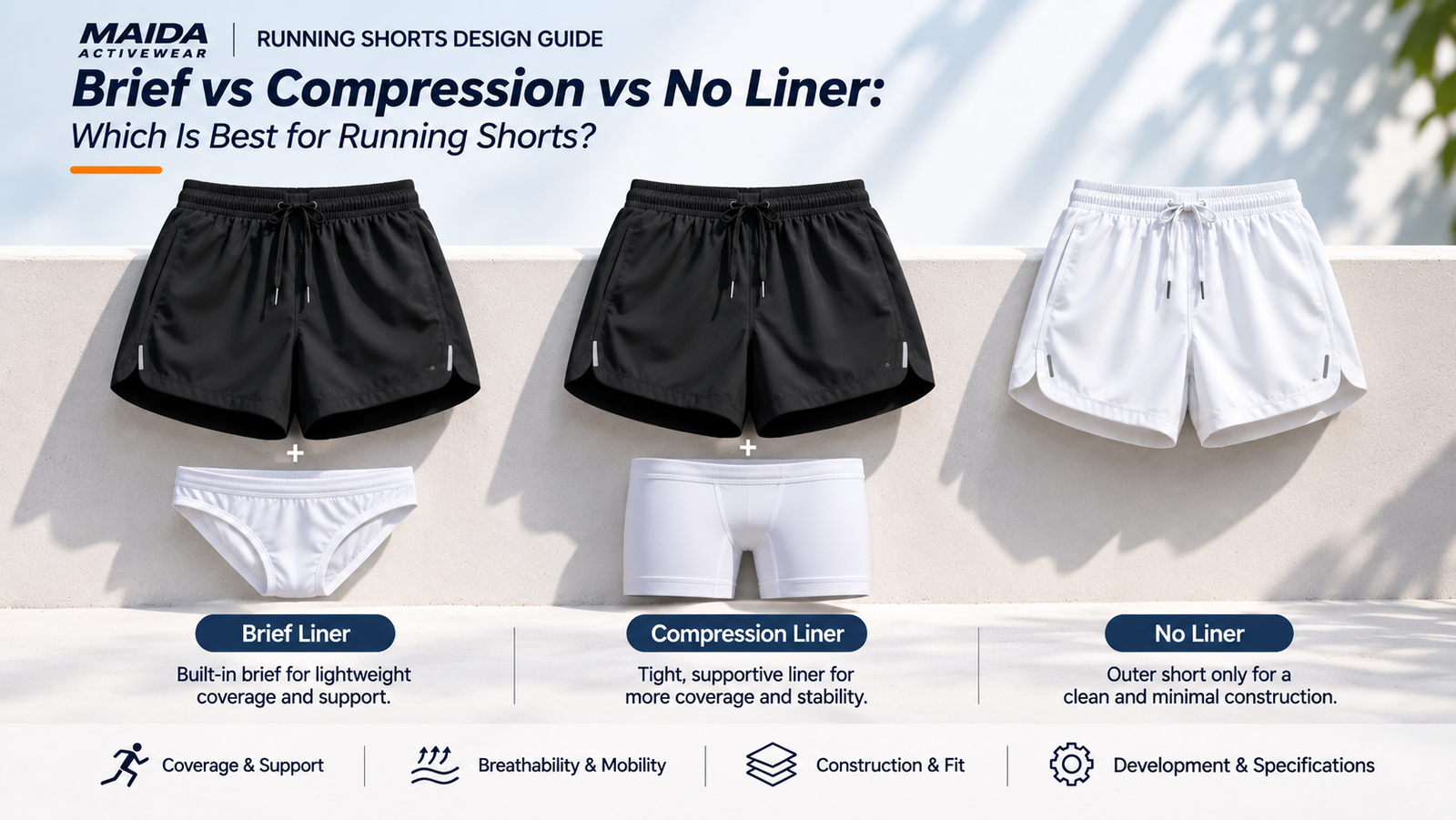
2. Brief Liner vs Compression Liner vs No Liner: What's the Difference?
Brief liner: less coverage, fewer layers down the thigh
A brief liner resembles underwear and sits inside a woven running-short shell. It often uses lightweight stretch knit or mesh, with shaped front and back panels and finished leg openings. The goal is comfortable coverage without adding a second layer along the upper thigh.
Check the crotch shape, leg elastic or binding tension, seam softness and where the liner meets the waistband. Excessively tight edges can dig in; loose edges may shift. A mesh fabric is not automatically comfortable simply because it has visible holes.
Compression-style liner: a closer-fitting inner short
A compression-style liner usually extends partway down the thigh. Its fit is developed using controlled negative ease—the pattern is smaller than the corresponding body measurement in selected areas—and fabric with suitable stretch and recovery. The intended hold must be balanced with freedom of movement.
A boxer liner is not necessarily a compression liner. Boxer or trunk liners describe an inner-short shape and length; compression additionally implies a deliberately close fit and controlled tension. Brands should describe the intended fit precisely rather than treating every two-in-one short as a compression product. Without garment-level pressure evidence, avoid medical or performance claims.
No liner: flexibility for the wearer
An unlined short has no integrated underwear-style layer. Customers can wear their preferred sports underwear or separate base layer. This can suit general training collections and audiences who dislike built-in liners.
Removing the liner also changes the product brief: the shell's opacity, inner seams, crotch construction and fit still need to be comfortable over a separate garment.
| Design choice | Brief liner | Compression-style liner | No liner |
|---|---|---|---|
| Inner structure | Underwear-shaped layer | Close-fitting thigh-length layer | Outer shell only |
| Main trade-off | Less thigh coverage | More coverage, warmth and material | Wearer chooses base layer |
| Critical fit check | Leg-edge pressure and crotch shape | Hem roll-up, tension and seam placement | Shell fit and underwear compatibility |
| Typical development concern | Binding and soft seams | Stretch recovery and fit grading | Coverage and inner seam finish |
3. Which Liner Works for Running, Gym Training and Hybrid Fitness?
For a lightweight running concept, a brief liner is a reasonable first sample if the target customer favors minimal coverage and a shorter outer shell. For runners who prefer more thigh coverage, test a boxer or compression-style design and compare friction and heat comfort during longer movement sessions.
Gym and hybrid-training users may value an unlined short because they can choose their own base layer. Others may prefer a fitted inner short during lunges, squats and repeated running. Neither preference is universal.
Do not choose based on activity labels alone. Test the same prototype in the actual movements expected of the wearer. Ask where it rubs, whether the liner rolls upward and whether the waistband stays stable when the athlete bends and accelerates.
A brand serving several audiences could start with one proven shell pattern and develop two carefully tested inner-layer options. However, switching liners may change the waist fit, crotch interaction and overall sample behavior; it is not just a label change.
4. What Fabrics Are Best for Running Shorts Liners?
Liners are commonly made from stretch knit fabrics, including lightweight mesh, jersey and more structured interlock-style knits. Polyester-elastane and nylon-elastane blends can both work, but neither fiber label proves breathability, drying speed or softness.
For a brief liner, prioritize skin comfort, gentle stretch, suitable opacity and stable leg-opening finishes. For a close-fitting inner short, pay closer attention to stretch force, recovery, surface friction and whether the fabric remains comfortable when damp.
A supplier comparison should include:
- Composition and weight: documented fiber content and grams per square metre (gsm), measured on the approved fabric.
- Stretch behavior: direction, extension under an agreed load and recovery after release.
- Hand feel: softness and seam comfort against skin, including when wet.
- Moisture and drying: test evidence before making “quick-dry” or moisture-wicking claims.
- Wash stability: shrinkage, twisting, colorfastness and changes in elasticity.
For example, ASTM D2594/D2594M concerns stretch and growth of low-power knitted fabrics. It is not the default answer for high-support compression constructions; ASTM D4964 addresses tension and elongation of elastic fabrics. Appropriate methods and acceptance criteria should be agreed with a testing provider. For laundering-related dimensional changes, AATCC TM135 is another relevant reference.
Do not promise a particular compression effect from an elastane percentage or gsm alone. The fabric must be evaluated together with the finished pattern and construction.
5. How Are Running Shorts Liners Constructed and Attached?
A factory-ready design must show how the liner joins the outer shell. Many integrated liners are captured within the waistband seam, but the exact attachment method depends on the waist structure, drawcord system and chosen pattern. Specify whether the liner is supported by a separate waist seam or incorporated with the elastic and shell layers.
For brief liners, examine the front and back panel shape, crotch allowance, binding or folded elastic around the leg opening, and any seam that could touch sensitive skin. The binding needs enough recovery to hold position without digging in.
For compression-style liners, define the inner inseam, crotch or gusset structure, seam location and leg-hem finish. A long liner with insufficient thigh ease may roll upward; adding a tight gripping band without testing can create a different comfort problem. Flat or low-profile seams are options, not automatic guarantees against chafing.
For unlined shorts, specify the inner leg seam finish, crotch construction, pocket bags and any exposed zipper tape. Removing the liner is not a reason to overlook inside workmanship.
Ask the sample team for front, back and inside-out photographs, plus a simple exploded construction diagram. Confirm that the drawing reflects actual sewable components: two separate outer legs, the liner's own body panels, and their documented connection points. The garment should never be represented as a skirt-like outer shell with a floating underwear layer beneath it.

6. How Can Brands Reduce Liner Ride-Up and Chafing?
Ride-up usually needs a pattern-and-material diagnosis rather than one universal fix. Examine inner inseam length, thigh opening, fabric recovery, crotch shape and whether the outer shell pulls on the liner during movement.
If a brief liner rubs, review the position and tension of its leg opening and any seam crossing a high-friction area. If a longer liner rolls, assess the hem circumference, length, fabric recovery and the position of its seams. If the waistband shifts, investigate elastic choice, relaxed waist measurement and how the two layers are joined.
Test on more than one body shape. Photograph standing, running, squatting and lunging positions, and write down the location and cause of each issue. Avoid declaring a design “anti-chafe” until the relevant wear testing supports that description.
7. How Should Brands Test and Specify a Custom Shorts Liner?
A detailed tech pack lets the sample room reproduce decisions consistently. Provide a front and back sketch, an inside view, a bill of materials and a measurement table covering both shell and liner. Record the liner type, composition, gsm, stretch direction, seam construction, waistband connection and leg-opening finish.
Measure the liner separately where relevant: front and back rise, crotch width, inner inseam, leg opening and waistband connection points. State whether each point of measurement is taken flat, doubled or along a seam. For fitted liners, define the intended size-specific fit and tolerances instead of copying outer-shell measurements.
Sample-review checklist:
- Try the garment during running, squats, lunges and seated movement.
- Check whether the liner moves independently or pulls against the outer shell.
- Inspect friction points, leg-edge pressure and any inner-thigh ride-up.
- Check comfort with and without pocket contents, if pockets are included.
- Wash according to the intended care instructions and remeasure key points.
- Record revisions, approve a final physical sample and archive its specification.
These are practical in-house screening steps, not standardized pass/fail laboratory tests. Where a brand needs quantified stretch, dimensional stability or colorfastness claims, agree on a suitable external test method and acceptance limits.
8. How Do Liner Options Affect Manufacturing Costs?
Adding a liner can change material consumption, cutting, handling, sewing time, elastic or binding use and inspection requirements. A brief liner may use fewer inner-fabric pieces than a long fitted liner, but actual costs depend on pattern efficiency, fabric price and seam complexity.
A compression-style inner short may require additional fit development and tests. Unlined versions remove liner operations, but the shell must still meet quality requirements. Request quotations against an approved bill of materials and construction, rather than assuming a fixed dollar difference between liner types.
MOQ may also vary by fabric, color and style. At MAIDA Activewear, published minimums are generally 50–100 pieces per design per color, with mixed sizes possible; confirm the final requirement for each custom construction before placing an order.
Frequently Asked Questions
Do you need underwear with lined running shorts?
Many integrated liners are designed to serve as the wearer's inner layer. However, comfort and hygiene preferences vary. Follow the garment's design guidance; an unlined short is normally paired with the wearer's preferred underwear or base layer.
Are two-in-one shorts the same as compression shorts?
Not necessarily. “Two-in-one” describes an outer short combined with an inner layer. That layer may be a fitted boxer-style short without a defined compression specification.
Which liner feels cooler in hot weather?
A brief liner uses less fabric over the thigh, but temperature comfort also depends on knit structure, fit, airflow, sweat and the outer shell. Test the finished garment rather than making a claim from liner shape alone.
Can brands offer lined and unlined versions of one design?
Yes, provided both versions are sampled and approved separately. Removing or changing a liner may affect fit, waistband construction and production cost.
Final Takeaway
Choose a liner around the wearer, not a marketing label. Compare brief, close-fitting and unlined prototypes for movement, skin comfort and repeatable construction. To develop custom running shorts with clear specifications, explore MAIDA's custom gym shorts and private-label FAQs.


